
The Square Mile
The City Inside London That Most People Know Nothing About

There is a city inside London.
It covers roughly one square mile.
It has its own government.
Its own mayoralty.
Its own police force.
Its elections include voters appointed through businesses and other organizations.
Its ancient guilds still participate in selecting important civic officials.
It possesses investment wealth accumulated over centuries.
It maintains an office specifically dedicated to representing its institutional interests before Parliament and government.
Its history is intertwined with the British monarchy.
It operates a financial structure that extends beyond that of an ordinary local authority.
And the financial district occupying this tiny jurisdiction became one of the most important centers of international banking and offshore finance on Earth.
This is the City of London, commonly called the Square Mile.
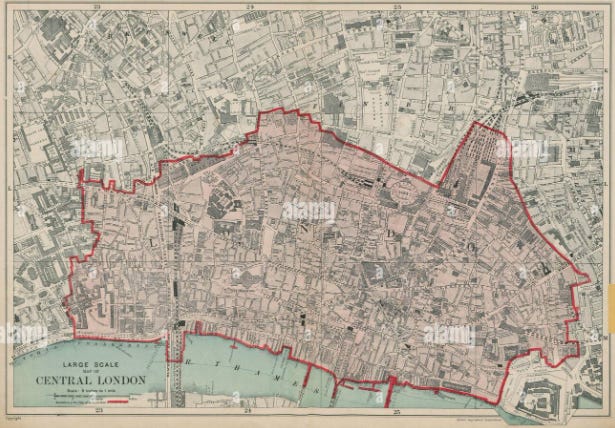
The City of London and London are not the same thing.
The structure can be found in records published by the City of London Corporation, Parliament, British legislation, the Bank of England, Companies House, financial regulators and the British government.
The remarkable part is how few people know how the system actually works.
When most people hear “London,” they picture Parliament, Buckingham Palace, Westminster, Big Ben and the enormous metropolis surrounding them.
That is Greater London.
Inside Greater London sits a much smaller jurisdiction:
the City of London.
The City is governed by the City of London Corporation.
It is divided into 25 wards.
It has its own governmental institutions and traditions.
It even has a different mayor.
Greater London has the Mayor of London, who leads the Greater London Authority.
The City of London has its own Lord Mayor, or Lady Mayor when the officeholder is a woman.
The current officeholder is Dame Susan Langley, the 697th person to hold the mayoralty and the first to use the title Lady Mayor.

The Corporation describes the officeholder as an international ambassador for the United Kingdom’s financial and professional-services sector.
The Lady Mayor leads international delegations, meets governments, policymakers and business leaders and promotes the UK’s financial and professional-services industries internationally.
The policing structure is different too.
Greater London is primarily policed by the Metropolitan Police.
The Square Mile has:
the City of London Police.
So before we discuss money, banking, Parliament, offshore finance or ancient privileges, understand the first fundamental fact:
this approximately one-square-mile territory is governed differently from the metropolis surrounding it.
A Government Whose Roots Predate Modern Britain
The institutional history goes back nearly a thousand years.
The Corporation traces its historic rights and privileges to before the Norman Conquest of 1066.
After William the Conqueror took England, a charter issued in 1067 recognized rights previously enjoyed by London’s citizens.
The office of Mayor dates to the twelfth century.
Henry FitzAilwin became the first recorded Mayor of London in 1189.
In 1199, King John granted London’s citizens the right to elect their own Sheriffs.
In 1215, their right to elect a Mayor was formally confirmed.
Then came one of the most famous documents in British constitutional history:
Magna Carta.
The City of London was specifically mentioned.
Its ancient liberties were protected.
The Corporation possesses a surviving 1297 Magna Carta, carrying the seal of Edward I.
Its institutions evolved through almost a millennium of relationships among commerce, monarchy, Parliament, law and finance.
Many disappeared or changed elsewhere.
A remarkable number survived here.
The Crown and the City
The relationship between the City and the British monarchy is ancient.
For centuries, London’s commercial wealth made the City enormously important to English monarchs.
The Corporation’s own historical material records the City’s role as a source of loans to monarchs financing government activities at home and abroad.
That relationship survives today principally through constitutional tradition, ceremony and civic institutions.
The Lord Mayor maintains historic relationships with the Monarchy and the Court of St James’s.
The Lord Mayor participates in the Accession Council.
The mayoral election itself retains an ancient connection with the Crown.
King John’s charter required the elected Mayor to be presented and to swear faithfulness to the sovereign.
The City’s Freedom ceremony retains similar language.
King Charles III and the late Queen Elizabeth II are among members of the Royal Family who have received the Freedom of the City of London.
There are elaborate ceremonies surrounding royal entry into the City, historically associated with Temple Bar and the presentation of the City’s sword.
The City of London is not a sovereign country separate from the United Kingdom. British law applies there, and Parliament remains sovereign.
What is unusual is the extraordinary degree of institutional continuity that survived inside Britain.
Who Actually Governs the Square Mile?
City government has several layers.
The Court of Common Council is the Corporation’s principal decision-making body.
There is also the Court of Aldermen.
Each of the City’s 25 wards elects an Alderman.
Then there is the powerful Policy and Resources Committee.
Its chairman is one of the City’s most significant political figures.
The current Policy Chairman is Chris Hayward.


The Corporation describes the Policy Chairman’s responsibilities as including advocacy for London as an international financial and professional-services centre.
Then there is the Lady Mayor.
The current Lady Mayor, Dame Susan Langley, comes from the financial-services industry herself.
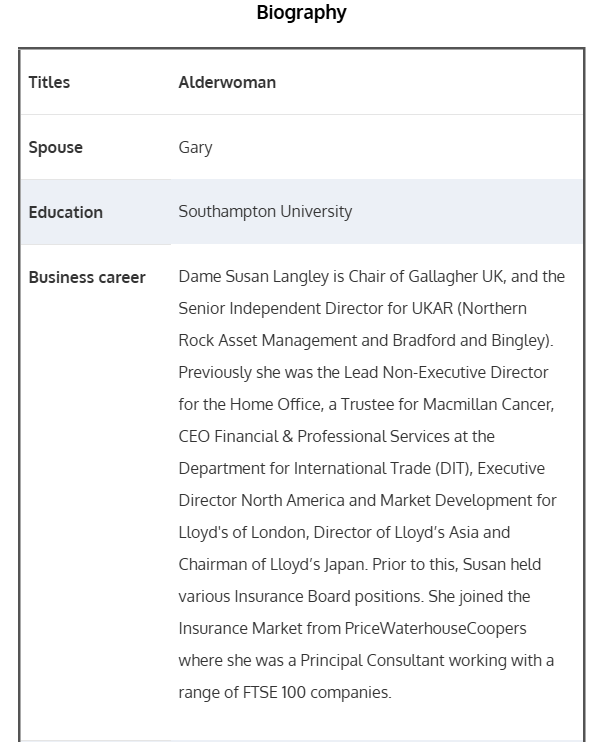
She is Chair of Gallagher UK and has held senior positions across business and financial services.
During the mayoral year, the officeholder leads international business delegations and engages directly with policymakers, governments and business leaders.
The Corporation is simultaneously a local government and an institution whose senior representatives openly advocate internationally for Britain’s financial and professional-services sector.
That economic diplomacy is part of the stated job.
Businesses Participate in the Electoral System
Now we arrive at one of the strangest features of the Square Mile.
Businesses and other qualifying organizations can participate in the City’s electoral system by appointing eligible individuals as workplace voters.
The Corporation openly describes the City as unique because businesses and other organizations can register voters for local elections.
The number of workplace voters an organization may appoint depends upon the size of its qualifying workforce.
For smaller organizations, the allocation increases according to workforce size.
For organizations with more than 50 qualifying workers, the formula provides ten voters for the first 50 workers and one additional voter for each further 50 workers.
Consider a qualifying organization with 2,000 workers.
The formula can produce approximately:
49 workplace voters.
A bank or corporation does not receive a stack of ballot papers and cast all of them itself.
It appoints eligible human beings to the electoral roll.
Those individuals cast secret ballots.
They are not legally required to vote according to instructions from the organization that nominated them.
One person cannot accumulate dozens of votes.
Nevertheless, the institutional fact remains remarkable:
workforce size creates electoral representation in the local government of the City of London.
And this is not simply an obscure medieval practice accidentally surviving into modern Britain.
Parliament enacted the City of London (Ward Elections) Act 2002, establishing the contemporary framework.
Businesses nominate workplace voters.
Workplace representation itself is absolutely real.
The Livery Companies
Then there are the Livery Companies.
Their origins lie in medieval trade and craft guilds.
Historically, these organizations regulated trades, established professional standards, controlled apprenticeships and exercised considerable political and economic influence within the City.
They survived.
Today there are more than 100 Livery Companies, encompassing both ancient trades and modern professions.
The names of the older companies sound like something from another age:
Mercers.
Grocers.
Drapers.
Fishmongers.
Goldsmiths.
Merchant Taylors.
Haberdashers.
But the Livery system evolved with the economy.
Modern Livery Companies represent professions and industries that did not exist in medieval England.
The significance of the Livery is not merely ceremonial.
It remains connected to City government.
Common Hall, the Lord Mayor and the Sheriffs
Every year, members of the Livery assemble at Common Hall.
They participate in the process through which the Lord Mayor is selected.
The candidate must already have progressed through the City’s civic hierarchy, including service as an Alderman and Sheriff.
The Livery also elects the City’s two Sheriffs.
In June 2026, Common Hall elected:
Prem Babu Goyal
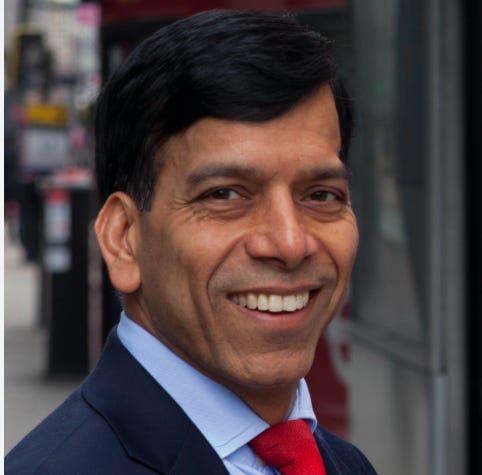
and
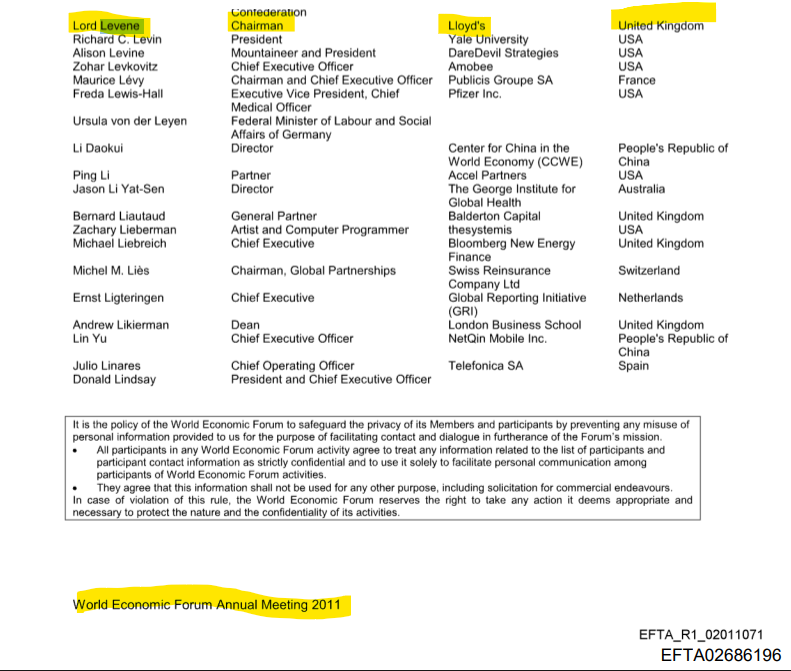
Timothy Charles Levene
as Sheriffs.

His father:
These are not sheriffs in the American law-enforcement sense.
The office is ancient.
The Sheriffs support the Lady Mayor’s civic, diplomatic and ceremonial work and maintain an important relationship with another extraordinary City institution:
the Old Bailey.
The Old Bailey
The Central Criminal Court of England and Wales is better known around the world as:
the Old Bailey.
It stands within the City of London.
The relationship between the Corporation, its Sheriffs and the Old Bailey is another surviving component of the City’s historical institutional structure.
The Sheriffs have responsibilities associated with the court and are traditionally described as custodians of the Old Bailey.
So within the same Square Mile we find municipal government, a separate police force, international financial institutions, ancient guild organizations, Sheriffs and one of the most famous criminal courts in the world.
The Freedom of the City
Another institution that survived into the twenty-first century is the Freedom of the City of London.
Historically, becoming a Freeman had enormous practical importance.
It could affect a person’s right to trade and participate in City life.
Today much of that practical significance has disappeared.
The ceremony survives.
The Livery Companies remain closely connected with the institution.
Members of the Royal Family, political leaders, military figures and prominent international personalities have received the Freedom.
Another medieval civic institution therefore remains embedded within the modern ceremonial and institutional life of one of the world’s major financial centers.
The Remembrancer
Now we arrive at perhaps the least understood office in the entire City:
the City Remembrancer.
The office dates to 1571.
Its historical purpose involved protecting and communicating the City’s interests to government and Parliament.
More than four centuries later, the parliamentary function survives.
The City Remembrancer’s Office is officially registered by Parliament among its Parliamentary Agents.
Parliament currently lists:
Paul Double
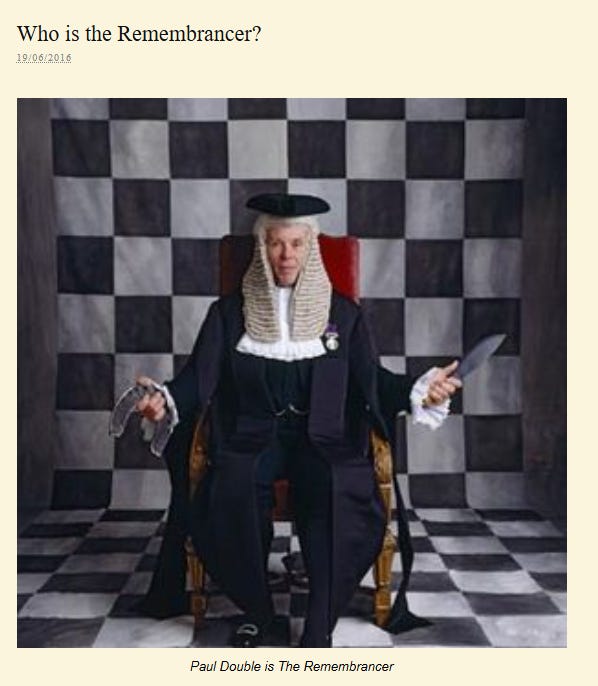
and
Paul Wright

as Roll A Parliamentary Agents associated with the City Remembrancer.
This is not merely an ancient title surviving on a plaque somewhere in Guildhall.
The office remains active.
On June 23, 2026, Paul Wright appeared before a parliamentary committee considering the City of London (Markets) Bill.
His official identification:
Remembrancer and Parliamentary Agent at City of London Corporation.
Paul Double also appeared for the Corporation.
The committee also heard from lawyers and Corporation officials.
This happened in 2026.
What Does the Remembrancer Actually Do?
The Remembrancer does not possess a unique constitutional seat among elected MPs.
The office does, however, perform parliamentary work on behalf of the Corporation.
Parliament formally recognizes the City Remembrancer as a Parliamentary Agent.
The documented reality is therefore straightforward:
a municipal corporation whose history stretches back centuries maintains a specialized parliamentary operation representing its interests before Britain’s legislature.
The City Can Promote Private Legislation
The Corporation can also promote private Bills in Parliament relating to its responsibilities and interests.
Again, this is happening now.
The City of London (Markets) Bill is a current example.
Parliament identifies:
The City Remembrancer
as the parliamentary agent for the promoter.
The Bill concerns legislation relating to Billingsgate Market and the London Central Markets.
Private legislation is not exclusive to the City.
But it provides a concrete modern example of the Corporation using established parliamentary procedures to pursue legislation affecting its functions.
Mansion House
Then there is Mansion House.
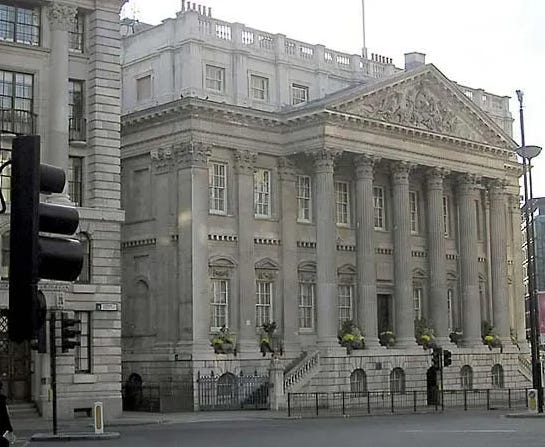
It is the official residence of the Lord Mayor of the City of London.
For generations it has provided a meeting place between the City, British government, central banking and international finance.
Senior politicians speak there.
Bank of England governors speak there.
International leaders are received there.
Financial executives attend events there.
The Lord Mayor hosts diplomatic and business gatherings there.
This is where ceremonial City government and modern financial diplomacy visibly meet.
The Mansion House Speeches
Chancellors of the Exchequer and Governors of the Bank of England have repeatedly used major City gatherings at Mansion House to speak about:
banking,
financial regulation,
monetary policy,
capital markets,
international finance,
economic policy,
technology,
and the future structure of Britain’s financial system.
The Mansion House speech has consequently become part of the institutional dialogue between Britain’s government, central bank and financial establishment.
And that brings us to Mark Carney.
Mark Carney and the Modern City
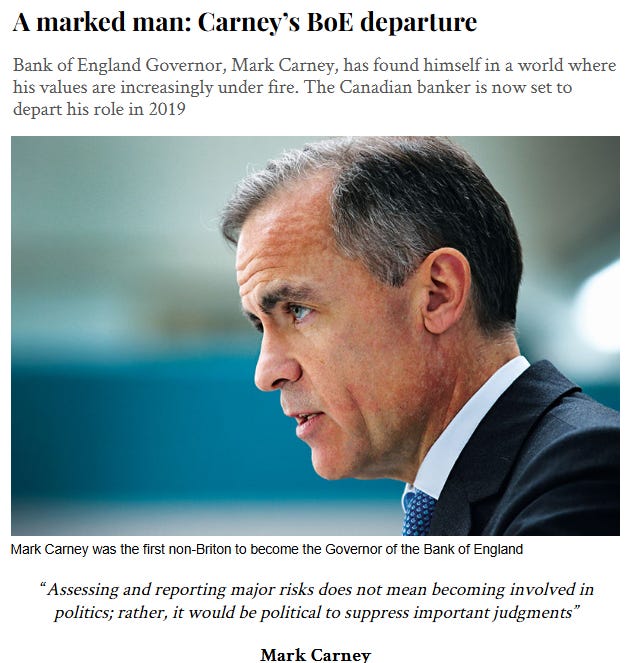
Before becoming Prime Minister of Canada, Mark Carney occupied one of the most important positions in British finance.
He served as Governor of the Bank of England from 2013 until 2020.
Before his central-banking career, Carney worked for Goldman Sachs, with professional experience that included London, Tokyo, New York and Toronto.
He subsequently became Governor of the Bank of Canada.
As Bank of England Governor, he chaired the Bank’s Monetary Policy Committee and Financial Policy Committee.
Carney also chaired the Financial Stability Board, an international body coordinating financial regulatory policy among national authorities and international standard-setting organizations.
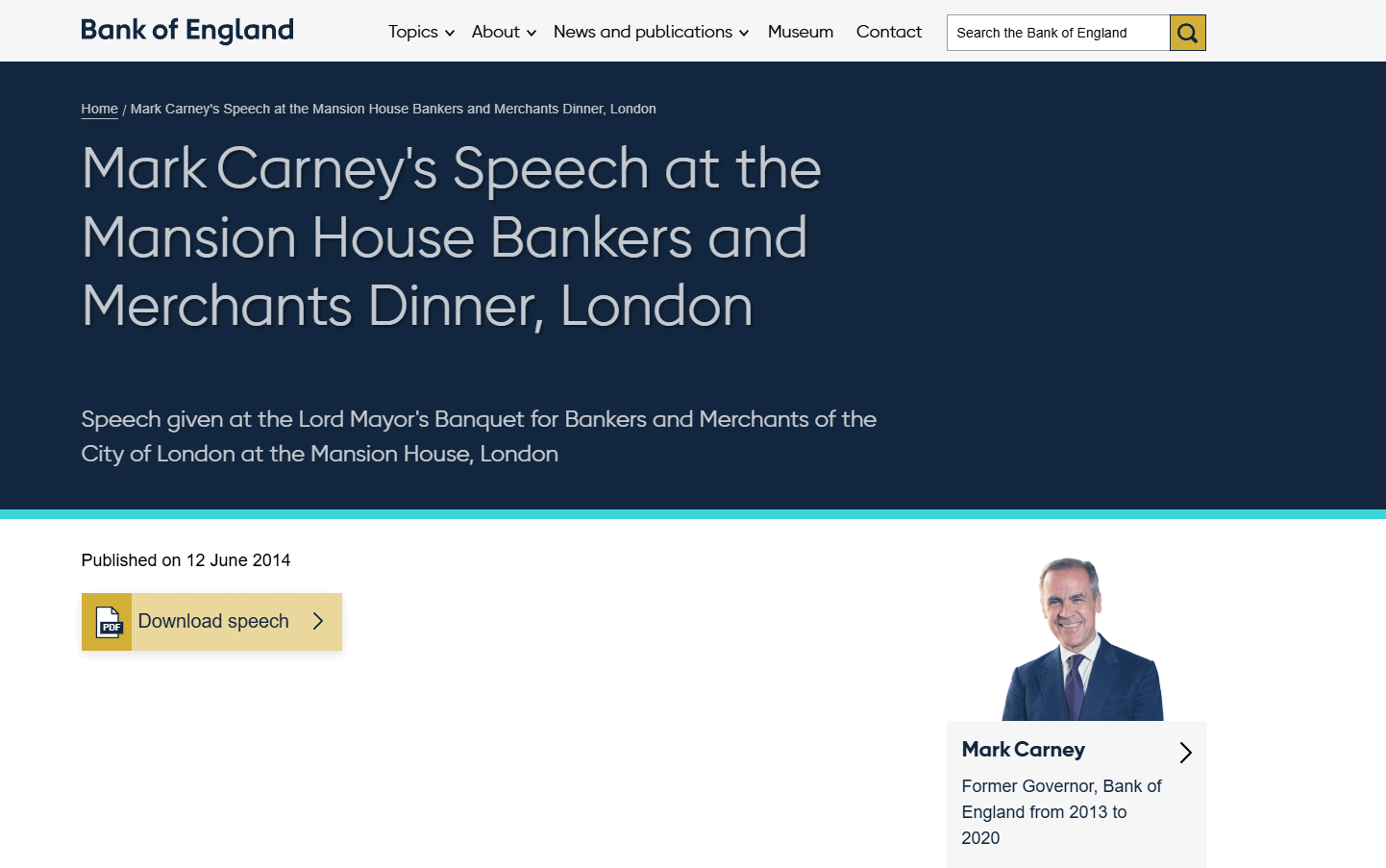
And Carney repeatedly addressed the City’s financial establishment at Mansion House.
He spoke at the Lord Mayor’s Bankers and Merchants Dinner in 2014.
Again at Mansion House in 2015.
Again in 2018.
Again in 2019.
His speeches dealt with the structure, regulation and future of finance; including globalization, technological transformation and sustainable finance.
The Bank of England
The Bank of England is located within the City of London.
It is Britain’s central bank.
It is institutionally separate from the City of London Corporation.
The same distinction applies to many institutions associated with the Square Mile.
They occupy the same financial ecosystem without being the same organization.
That ecosystem includes or has historically included:
the Bank of England,
the London Stock Exchange,
Lloyd’s of London,
major British and international banks,
insurance companies,
asset managers,
investment firms,
law firms,
accounting firms,
and enormous professional-services businesses.
This concentration is one reason “the City” became shorthand around the world for British finance.
The City Has Its Own Wealth
The Corporation also possesses a financial structure that requires explanation.
There is the City Fund.
This finances ordinary local-authority functions.
But then there is:
City’s Estate.
Historically, it was called:
City’s Cash.
City’s Estate is an endowment accumulated through property and investments over approximately eight centuries.
The Corporation therefore does not simply collect annual taxation and spend it like an ordinary municipal authority.
It also manages assets accumulated across generations.
Property
Property is central to that story.
The Corporation maintains professional management of its property interests through its City Surveyor functions.
Those responsibilities include investment property, corporate real estate and major construction and development projects.
This gives the Corporation another unusual dimension:
it is simultaneously a local governmental authority and the manager of substantial property and investment interests.
And in a jurisdiction containing some of the world’s most valuable commercial real estate, planning and property policy carry enormous economic significance.
Business Rates and the City Premium
Businesses occupying property in the City generally pay Britain’s non-domestic property tax known as business rates.
But the City has an additional feature.
For 2026/27, the Corporation states that its own City multipliers add 2.9 pence in the pound for qualifying small businesses and 3.2 pence for other businesses on top of the national rating multiplier.
The Corporation explains that this additional funding supports:
policing, security, resilience and contingency planning in the City.
The Court of Common Council determines the City premium annually.
That creates another direct financial relationship between the enormous business community operating inside the Square Mile and the institutions governing it.
City Bridge Foundation
Then there is another extraordinary pool of historic wealth:
City Bridge Foundation.
The Corporation is the sole trustee.
The foundation owns and maintains five Thames crossings:
Tower Bridge
London Bridge
Southwark Bridge
Millennium Bridge
Blackfriars Bridge
Its assets developed over centuries from funds originally associated with maintaining London Bridge.
Over time, investment returns generated resources beyond bridge maintenance.
Those resources now also support charitable activity across London.
A centuries-old fund created around London’s bridges therefore evolved into a major modern charitable institution.
Ancient wealth.
Modern function.
That pattern appears repeatedly throughout the City.
London Was a Financial Centre Long Before Eurodollars
The City’s financial importance did not begin in the twentieth century.
By the nineteenth century, London had become one of the central financial marketplaces of the world.
Britain’s commercial and imperial reach produced enormous networks involving:
international trade,
shipping,
marine insurance,
commodity finance,
government borrowing,
foreign sovereign debt,
banking,
and securities markets.
Capital flowed through London from around the world.
Sterling itself became a major international currency.
London was therefore already positioned to play a central role when international finance changed dramatically after the Second World War.
The Eurodollar Revolution
This is one of the most important parts of the entire story.
After the Second World War, London became a principal center of the Eurodollar market.
The name is confusing.
A Eurodollar has nothing inherently to do with today’s euro currency.
A Eurodollar traditionally refers to:
a US-dollar deposit booked at a bank outside the United States.
Think about what that means.
The world’s dominant currency could circulate through banking institutions outside the country issuing it.
London became one of the great centers of that market.
Banks could:
borrow dollars,
lend dollars,
accept dollar deposits,
finance international transactions,
and create dollar-denominated financial instruments,
without the entire transaction necessarily occurring inside America’s domestic banking system.
The Bank of England was documenting the rapid expansion of London’s foreign-currency deposit markets by the 1960s.
This helped transform international finance.
Offshore Structures
The offshore world involves different legal structures serving different purposes.
These include:
companies
trusts
foundations
partnerships
special-purpose vehicles
investment funds
holding companies
and other legal entities.
A company might be incorporated in one jurisdiction.
Its directors might live in another.
Its bank might operate in London.
Its investors might live in several different countries.
Its assets might be held somewhere else entirely.
Its investment manager might operate from yet another jurisdiction.
Multinational businesses and investment funds routinely use cross-border structures.
But complex chains of ownership can make answering one seemingly simple question extraordinarily difficult:
Who ultimately owns the asset?
That is where beneficial ownership becomes important.
Beneficial Ownership
The beneficial owner is the person who ultimately owns or controls an entity or benefits from its assets, even where another company, trustee or nominee appears in the formal paperwork.
The British government has acknowledged the importance of obtaining beneficial-ownership information for combating:
corruption,
money laundering,
terrorist financing,
and other financial crime.
In 2016, the UK entered arrangements with Crown Dependencies and several Overseas Territories designed to improve law-enforcement access to beneficial-ownership information.
Those arrangements matter because international corporate structures can cross numerous legal jurisdictions.
Britain’s Offshore Network
Now look beyond London.
A number of jurisdictions linked constitutionally to Britain became major international financial centers.
Among them:
Cayman Islands
British Virgin Islands
Bermuda
Jersey
Guernsey
Isle of Man
They are not constitutionally identical.
That is important.
The Crown Dependencies
Jersey, Guernsey and the Isle of Man are Crown Dependencies.
They are not part of the United Kingdom.
They have their own legislatures.
Their own legal systems.
Their own fiscal systems.
Their own administrations.
They have historic constitutional relationships with the British Crown.
They also became important centers for areas such as banking, trusts, funds, wealth management and corporate services.
The British Overseas Territories
Cayman Islands, British Virgin Islands and Bermuda, by contrast, are British Overseas Territories.
Several British Overseas Territories became globally important financial centers.
The British government’s beneficial-ownership work has specifically dealt with Overseas Territories possessing established financial centers, including:
Bermuda,
British Virgin Islands,
Cayman Islands,
Gibraltar,
Anguilla,
and Turks and Caicos.
What emerges is a network of distinct jurisdictions connected through history, constitutional relationships, law, professional services and international capital.
London as the Crossroads
This is where the larger architecture becomes visible.
Imagine capital raised in Canada.
A fund incorporated in Cayman.
A holding company incorporated elsewhere.
Legal documents prepared in London.
Insurance written through London.
Assets located in Europe.
Investors spread across North America, Asia and the Middle East.
A bank operating in several jurisdictions.
None of this requires bags of cash crossing borders.
Modern finance consists largely of contracts, securities, ownership interests, accounting entries and legal claims.
London became extraordinarily important because so much of the expertise necessary to construct those transactions became concentrated there.
Banks.
Lawyers.
Accountants.
Insurers.
Fund managers.
Traders.
Markets.
Regulators.
Corporate-service providers.
That is what makes a financial center powerful.
International Economic Diplomacy
The City Corporation openly promotes Britain’s financial and professional-services sector internationally.
The Lady Mayor travels.
Business delegations travel.
Foreign leaders visit Mansion House.
Policymakers meet financial executives.
Agreements involving financial cooperation are discussed.
The Policy Chairman advocates for the sector.
This is institutional economic diplomacy conducted openly.
And it helps explain why the office of Lord Mayor remains important despite being unknown to many people outside Britain.
The Mayor of London represents Greater London politically.
The Lady Mayor of the City of London represents something quite different:
a historic municipal corporation sitting at the center of Britain’s financial establishment and acting internationally as an ambassador for its financial and professional-services industry.
Sustainable and Climate Finance
Another modern dimension demonstrates how the City’s financial role continues to evolve.
The City Corporation is actively involved in green and sustainable finance.
It has developed sustainable-finance initiatives and financing frameworks.
Its investment activities incorporate climate-related considerations.
The broader London financial industry has also become an important marketplace for green bonds, sustainability-linked finance, ESG investment products and climate-related financial services.
Sustainable finance is now an explicit component of the modern financial ecosystem surrounding the City.
Mark Carney, Sustainable Finance and International Financial Governance
This brings Mark Carney back into the story.
During and after his Bank of England tenure, Carney became an internationally prominent advocate for incorporating climate-related financial risk into the financial system.
His career intersects several major themes running through this story:
central banking,
the City,
Mansion House,
international financial governance,
globalization,
and sustainable finance.
Those relationships are public.
Jeffrey Epstein and the British Financial Establishment
There is another connection within Britain’s banking establishment that has been formally established by British regulators.
It concerns Jeffrey Epstein and Jes Staley.
Staley eventually became Chief Executive of Barclays, one of Britain’s most important banking institutions.
He had previously maintained an extensive relationship with Epstein.

Britain’s Financial Conduct Authority investigated representations made about that relationship.
In 2025, the Upper Tribunal upheld the FCA’s decision banning Staley from senior management roles in financial services.
According to the FCA, Staley approved a letter containing misleading statements concerning the nature of his relationship with Epstein and their last point of contact.
Emails examined during the regulatory process showed Staley describing Epstein as one of his “deepest” and “most cherished” friends.
The FCA concluded that Staley had acted recklessly and lacked integrity.
Those are findings from Britain’s financial regulator and tribunal process.
They establish a documented Staley-Epstein relationship and a connection between Epstein and the former chief executive of Barclays.
Ghislaine Maxwell
Then there is Ghislaine Maxwell.
Maxwell was British-born.
She was the daughter of publishing magnate Robert Maxwell.
Her relationship with Jeffrey Epstein is established extensively in the public record and through the American criminal proceedings that resulted in her conviction.
There is also a British corporate record.
Companies House records identify Maxwell as having been a director of Ellmax Enterprise Limited, a British company incorporated in 2012.
Companies House subsequently recorded her as a person with significant control through ownership of at least 75% of its shares.
The company was later dissolved.
Prince Andrew, Epstein and Maxwell
If Jeffrey Epstein and Ghislaine Maxwell are discussed in a British context, another name cannot reasonably be omitted:
Prince Andrew, Duke of York.
Andrew’s association with Epstein and Maxwell became one of the most consequential scandals involving the modern British Royal Family.
Andrew publicly discussed his association with Epstein during his 2019 BBC Newsnight interview.
He subsequently stepped back from public duties.
In 2022, Buckingham Palace announced that, with Queen Elizabeth II’s approval, Andrew’s military affiliations and royal patronages had been returned to the Queen and that he would continue not to undertake public duties.
Andrew later settled the civil lawsuit brought against him by Virginia Giuffre, without admitting liability.
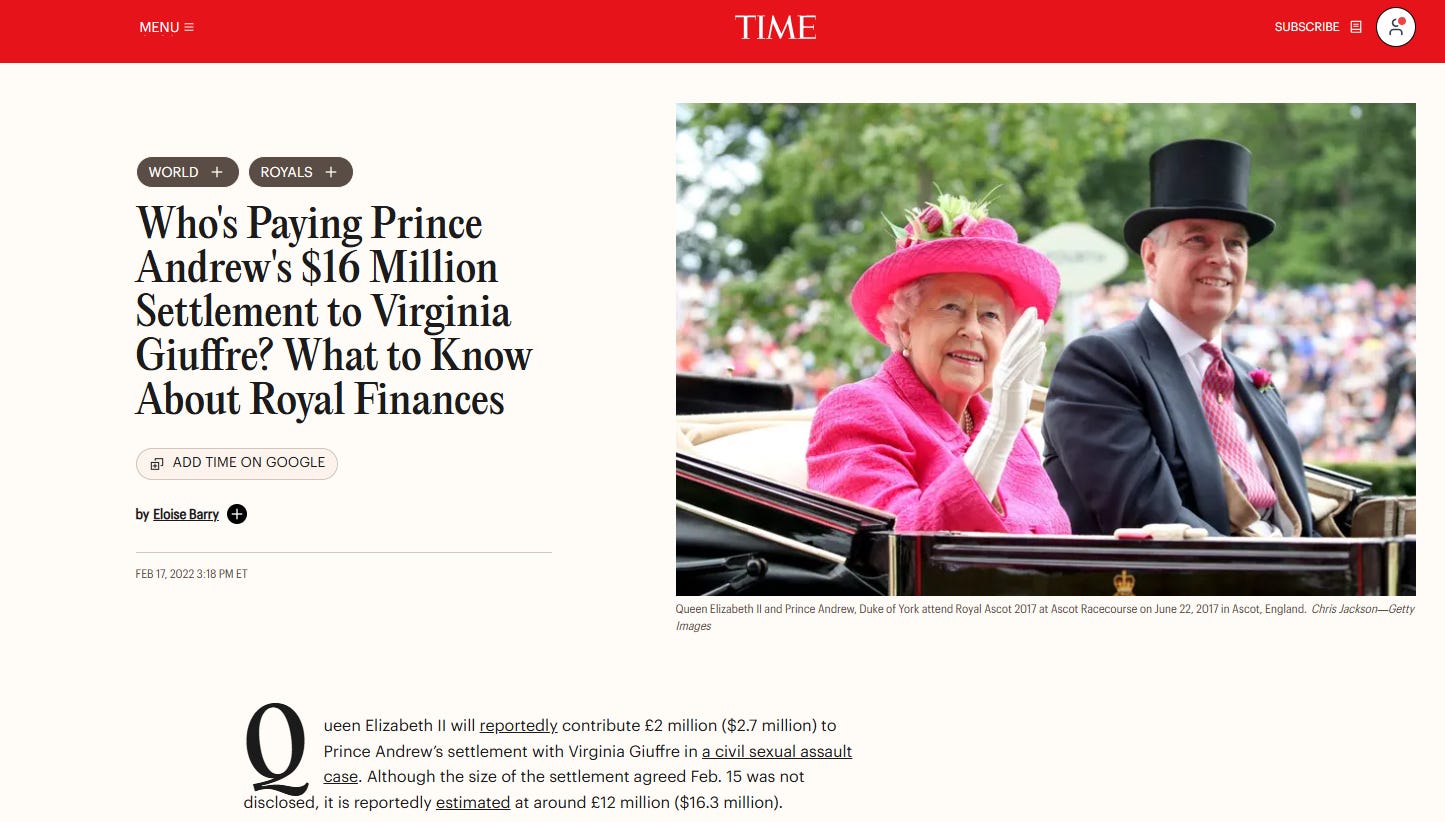
The existence of Andrew’s association with Epstein and Maxwell is therefore documented.
He served no jail time for this case.
The Royal Family, Parliament, the Bank and the City
The Crown,
the Royal Family,
the British government,
Parliament,
the Bank of England,
and the City of London Corporation
are separate institutions.
They nevertheless intersect historically, constitutionally, economically and ceremonially.
The City has an ancient relationship with the Crown.
The Lady Mayor participates in royal and state ceremonies.
Royal figures have received the Freedom of the City.
The City’s ancient charters were issued or confirmed by monarchs.
The Bank of England sits geographically within the Square Mile.
Government ministers and central bankers address financial leaders at Mansion House.
The Remembrancer represents Corporation interests in parliamentary proceedings.
The relationships are therefore institutional and visible.
Now Bring This Back to Canada
For Canadians, this history is not simply an interesting story about medieval London.
Canada operates inside the same international financial architecture.
And Canada’s current Prime Minister has spent a substantial part of his professional life inside some of its most important institutions.
Mark Carney’s career runs directly through that architecture.
Before becoming Prime Minister of Canada, he:
worked at Goldman Sachs,
served as Governor of the Bank of Canada,
chaired the Financial Stability Board,
served as Governor of the Bank of England from 2013 to 2020,
participated in international financial governance,
became a major international advocate for sustainable finance,
and repeatedly addressed the financial establishment at Mansion House in the City of London.
That gives Canadians an unusually direct connection between their present political leadership and the international financial institutions discussed throughout this article.
Canada Participates in International Financial Governance
Canada does not create its banking and financial rules alone.
Canadian institutions participate in international bodies and regulatory frameworks including:
the Financial Stability Board,
the Bank for International Settlements,
and international banking standards developed through the Basel Committee.
These institutions exist specifically so governments, central banks and financial regulators can coordinate standards across national borders.
Their work can involve:
bank capital requirements,
liquidity,
systemic financial risk,
cross-border banking,
resolution of financial institutions,
payments,
financial stability,
and other regulatory standards.
Canada participates in that system.
Canadian Banks Are International Banks
Canada’s largest financial institutions operate internationally.
They own foreign subsidiaries.
They lend internationally.
They borrow internationally.
They participate in global securities markets.
They maintain assets and liabilities outside Canada.
Canadian regulators specifically collect information concerning financial exposures booked outside Canada.
The Canadian banking system therefore cannot be understood simply by looking inside Canada’s borders.
Its balance sheets participate in global finance.
Canadian Pension Capital Is Global Capital
The same is true of Canada’s enormous pension funds.
Canadian pension institutions invest around the world in:
infrastructure,
real estate,
private equity,
public equities,
credit,
energy,
utilities,
transportation,
technology,
and other assets.
At the same time, foreign institutional investors invest heavily in Canada.
Capital therefore moves in both directions.
A Canadian retirement fund can own infrastructure in Britain.
A foreign pension fund can own Canadian infrastructure.
A Cayman-domiciled investment vehicle can contain investors from numerous countries.
A London asset manager can manage capital originating elsewhere.
A Canadian corporation can borrow from international lenders.
This is how modern capital markets operate.
Who Actually Owns Canadian Assets?
That leads directly to one of the most important questions Canadians can ask:
Who ultimately owns Canadian assets?
A corporation can operate in Canada without all of its owners being Canadian.
A Canadian-listed company can have major foreign institutional shareholders.
A fund investing in Canadian infrastructure can be domiciled somewhere else.
A Canadian company can have subsidiaries across numerous jurisdictions.
A parent company can own another company, which owns another company, which ultimately owns an asset located in Canada.
That is why beneficial ownership matters.
Canada and Beneficial Ownership
Canada has strengthened federal beneficial-ownership reporting.
Corporations governed by the Canada Business Corporations Act are required to identify individuals with significant control.
That means identifying the human beings who ultimately own or exercise significant control over the corporation.
FINTRAC specifically recognizes hidden beneficial ownership and complex legal structures as vulnerabilities that can facilitate financial crime.
This tells us something important.
Even governments recognize that the name appearing on the front of a corporation does not necessarily tell you who ultimately controls the economic interest behind it.
Following ownership requires going deeper.
Canada and Britain
Canada also maintains substantial commercial and financial relationships with Britain.
Those relationships span:
trade,
investment,
banking,
insurance,
asset management,
professional services,
technology,
energy,
and capital markets.
London remains Britain’s principal international financial center.
Canadian businesses and investors therefore regularly interact with financial institutions operating within London’s ecosystem.
The historical political relationship between Canada and Britain has changed enormously since Confederation.
The financial relationship did not disappear.
It evolved.
Sustainable Finance Comes to Canada
Then there is sustainable finance.
Carney played an important international role in promoting climate-related financial disclosure and the integration of climate-related risks into financial decision-making.
Canada participates in international organizations working on many of the same issues.
These frameworks influence how:
banks assess risk,
corporations disclose information,
institutional investors allocate capital,
insurers price risk,
and pension funds evaluate investments.
This makes sustainable finance much more than environmental policy.
It is capital-allocation policy.
When financial institutions decide that particular risks must be measured, disclosed or priced differently, those decisions can affect where enormous amounts of money flow.
Critical Minerals, Energy and Canadian Resources
This becomes particularly important when discussing Canada’s natural resources.
Canada possesses enormous reserves and production potential involving:
oil,
natural gas,
uranium,
potash,
nickel,
copper,
lithium,
cobalt,
rare-earth elements,
and other strategically important commodities.
Critical minerals have become central to international economic and national-security policy.
Developing those resources requires enormous amounts of capital.
That raises straightforward questions:
Who provides that capital?
Which investment funds participate?
Where are those funds domiciled?
Who manages them?
Who owns them?
Which banks finance the projects?
What equity is exchanged for investment?
Who owns the infrastructure?
Who owns the processing facilities?
Where are the commodities sold?
Where do the profits ultimately flow?
Those questions determine who ultimately benefits economically from Canadian resources.
Infrastructure
The same questions apply to Canadian infrastructure.
Ports.
Airports.
Roads.
Energy infrastructure.
Electricity transmission.
Telecommunications.
Data centers.
Housing.
Rail.
Pipelines.
Mining infrastructure.
Public-private partnerships.
When international capital participates in these assets, Canadians should understand the ownership structure.
Who supplies the equity?
Who supplies the debt?
What guarantees exist?
What government commitments exist?
Who receives the long-term revenue?
Where is the investment vehicle incorporated?
Who ultimately owns it?
Those are not ideological questions.
They are financial questions.
The Question Canadians Should Be Asking
The Canadian story is therefore larger than Mark Carney personally.
It is about understanding the financial architecture within which Canadian governments operate.
Canada participates in a transnational financial system in which:
governments,
central banks,
commercial banks,
regulators,
institutional investors,
pension funds,
asset managers,
insurance companies,
international organizations,
and multinational corporations
interact constantly across borders.
Carney is particularly relevant because few Canadian political leaders have ever entered office with a résumé so deeply embedded in that architecture:
Goldman Sachs → Bank of Canada → Financial Stability Board → Bank of England → international sustainable finance → Prime Minister of Canada.
Those institutions matter.
Their policies matter.
Their capital matters.
Their relationships matter.
And Canadians should understand them.
Follow the Money in Canada Too
When Canadians hear that billions of dollars are being invested in Canada, the first question should not simply be:
How much?
Ask:
Whose money?
Who owns the fund?
Where is it domiciled?
Who manages it?
What does the investor receive?
What Canadian asset is being purchased?
What percentage is foreign-owned?
Who provided the debt?
What government guarantees exist?
Where will the profits go?
Who ultimately controls the asset?
What international regulatory framework applies?
Which organizations developed those standards?
Which Canadian officials participated in developing them?
Those questions can be answered.
Corporate registries exist.
Securities filings exist.
Government contracts exist.
Investment announcements exist.
Pension-fund reports exist.
Bank financial statements exist.
Regulatory filings exist.
Beneficial-ownership registries increasingly exist.
Follow them.
What Is Documented
A local governmental corporation with institutional roots reaching back before the Norman Conquest.
Ancient liberties recognized by royal charter.
A specific place in Magna Carta.
Twenty-five wards.
A separate mayoralty.
A separate police force.
A Court of Common Council.
A Court of Aldermen.
A Policy Chairman advocating for Britain’s financial and professional-services sector.
A Lady Mayor serving internationally as an ambassador for that sector.
Businesses and organizations nominating workplace voters.
A modern electoral framework established by Parliament.
More than 100 Livery Companies descended from ancient guild structures.
Liverymen participating in civic elections.
Sheriffs elected at Common Hall.
A continuing relationship between those Sheriffs and the Old Bailey.
The Freedom of the City.
A Remembrancer’s Office dating to 1571.
Parliamentary Agents acting for the Corporation.
A City Remembrancer appearing before Parliament in 2026.
The Corporation promoting private legislation.
Mansion House functioning as a meeting place among civic government, national government, central banking and international finance.
City’s Estate holding assets accumulated across centuries.
City Bridge Foundation owning and maintaining major Thames bridges.
A significant property portfolio.
A City business-rate premium supporting policing, security and resilience.
The Bank of England sitting geographically within the Square Mile.
One of the world’s greatest concentrations of banks, insurers, asset managers, lawyers, accountants and financial institutions.
London’s historical role in international finance.
The rise of the Eurodollar market.
Dollar banking conducted outside the United States.
Crown Dependencies serving as international financial centers.
British Overseas Territories serving as international financial centers.
Cross-border companies, trusts, investment funds and special-purpose vehicles.
Government agreements concerning beneficial ownership.
International financial diplomacy.
Sustainable finance.
Mark Carney’s Bank of England governorship and repeated Mansion House appearances.
Jes Staley’s documented relationship with Jeffrey Epstein.
Ghislaine Maxwell’s documented British background and corporate history.
Prince Andrew’s documented association with Epstein and Maxwell.
An ancient relationship between the Corporation and the British Crown.
And Canada’s current Prime Minister arriving in office after a career spanning Goldman Sachs, Canada’s central bank, international financial governance and Britain’s central bank.
These are pieces of a financial and institutional history extending across centuries and national borders.
Follow the Institutions
Read the records.
Read the Corporation’s election rules.
Read the City of London (Ward Elections) Act 2002.
Read the Livery rules.
Read the City’s financial accounts.
Read about City’s Estate.
Read about City Bridge Foundation.
Read the Remembrancer’s Office records.
Read Parliament’s register of Parliamentary Agents.
Read the 2026 City of London (Markets) Bill proceedings.
Read the Bank of England’s historical publications about London’s foreign-currency markets.
Read the British government’s documentation concerning Crown Dependencies and Overseas Territories.
Read its beneficial-ownership agreements.
Read Companies House.
Read the FCA findings concerning Jes Staley.
Read Mark Carney’s Mansion House speeches.
Read the public record concerning Prince Andrew, Epstein and Maxwell.
Then come back to Canada.
Read the Bank of Canada.
Read OSFI.
Read FINTRAC.
Read Canada’s beneficial-ownership registry.
Read pension-fund financial statements.
Read corporate securities filings.
Read foreign-investment announcements.
Read infrastructure agreements.
Read who owns the companies.
Read who finances them.
Read where the investment vehicles are domiciled.
And follow the capital.
Hiding in Plain Sight
Perhaps the most remarkable thing about the City of London is that its institutions are not hidden.
Its elections are public.
Its workplace-voting rules are public.
Its legislation is public.
Its officials have names.
Its committees publish records.
Its parliamentary representatives have names.
Its parliamentary appearances have transcripts.
Its accounts are published.
Its assets are reported.
Its business rates are published.
Its Livery Companies have websites.
Its financial institutions publish reports.
The Bank of England has archives.
Parliament has records.
Companies House has corporate filings.
Financial regulators publish enforcement decisions.
Government departments publish constitutional arrangements with Britain’s territories and dependencies.
The information exists.
What is missing is widespread understanding of how the pieces fit together.
Most people can spend their entire lives hearing the phrase “the City of London” without realizing that it refers to something institutionally different from London itself.
They may never hear about workplace voters.
They may never hear about the Remembrancer.
They may never understand Common Hall.
They may never know why medieval Livery Companies still matter.
They may never understand City’s Estate.
They may never know that the Corporation is trustee of the fund maintaining Tower Bridge and four other Thames crossings.
They may never understand what a Eurodollar actually is.
They may never distinguish a Crown Dependency from an Overseas Territory.
They may never understand why London became so important to offshore finance.
And Canadians may never ask how their own banking institutions, pension funds, corporations, regulators and political leaders fit into that much larger international financial architecture.
Yet the records are there.
One Square Mile, and a Much Larger System
Return to where we started.
Approximately one square mile.
A tiny geographic area.
But inside and around it sits an extraordinary concentration of history and institutions:
monarchy,
municipal government,
Parliamentary representation,
ancient guilds,
courts,
policing,
property,
central banking,
commercial banking,
insurance,
securities,
international capital,
offshore finance,
professional services,
and economic diplomacy.
The modern skyscrapers can make the Square Mile look like any other international financial district.
It isn’t.
Underneath them sits an institutional structure that has been evolving for nearly a thousand years.
Kings borrowed from it.
Royal charters protected it.
Magna Carta recognized its liberties.
Merchants organized within it.
Livery Companies grew from it.
Parliament legislated around it.
Banks congregated within it.
International markets developed through it.
Offshore dollars flowed through it.
Its Lady Mayor still travels internationally promoting British financial services.
Its Remembrancer’s Office still appears before Parliament representing the Corporation.
And today, the Prime Minister of Canada is a former Governor of the Bank of England and former Chairman of the Financial Stability Board whose professional career traversed many of the institutions at the center of modern international finance.
These are facts worth understanding.
Open the legislation.
Open Parliament’s records.
Open the Bank of England archives.
Open the Corporation’s accounts.
Look at the election rules.
Look at the Livery Companies.
Look at the Remembrancer.
Look at the offshore arrangements.
Look at the corporate registries.
Look at the Canadian regulatory records.
Look at the ownership structures.
Look at the names.
Look at the dates.
Follow the institutions.
Follow the ownership.
Follow the money.